Does My Baby Need to Crawl?
By Nicole Pates | Paediatric Physiotherapist | Western Kids Health
If your baby skipped crawling, or went about it in their own funny way, you have probably been told a few things. Maybe by a relative, maybe in a parenting group, maybe even by a professional. It usually comes out something like this: crawling is how a baby “connects the two sides of the brain,” and skipping it can cause trouble with coordination, reading or learning down the track. That is a horrible thing to have in your head when your baby is happy, busy, and grinning at you over their breakfast every morning.
Before I deep dive into it, for those therapists reading this thinking “Nicole hates crawling” – that’s not true. I love crawling. I love that babies can get around and explore their world, discover new things. Crawling has many benefits and it tells me so much about how your baby’s different systems (think brain, muscles, eyes, inner ear, sensations etc) are all working together. Crawling is great for your baby. But there is nothing magic about it, it is one good path rather than the only one.
This blog is looking at statement we all hear “The left and right halves of the brain need crawling to wire together, and crawling is the one movement that does it, because the arms and legs work on opposite sides of the body.”
What the claim says, and what your baby’s brain is really up to
So what is really happening?
The two halves of the brain are joined by a thick band of nerve fibres called the corpus callosum. It works a bit like a bridge, letting the left and right sides talk to each other. That bridge starts forming before your baby is even born. It keeps maturing all the way through childhood and into the teenage years, on its own biological schedule, shaped by genes and by a whole lot of ordinary day-to-day movement and sensory experience¹. There is no single movement that switches it on.
You can see this in children born with part or all of the corpus callosum missing, a condition called agenesis of the corpus callosum. What affects these children is the missing structure itself, and whether they crawled makes no difference to that². If crawling built the bridge, then crawling could fix it being missing. It cannot.
What crawling is genuinely good for
Crawling has real benefits, and they are worth caring about.
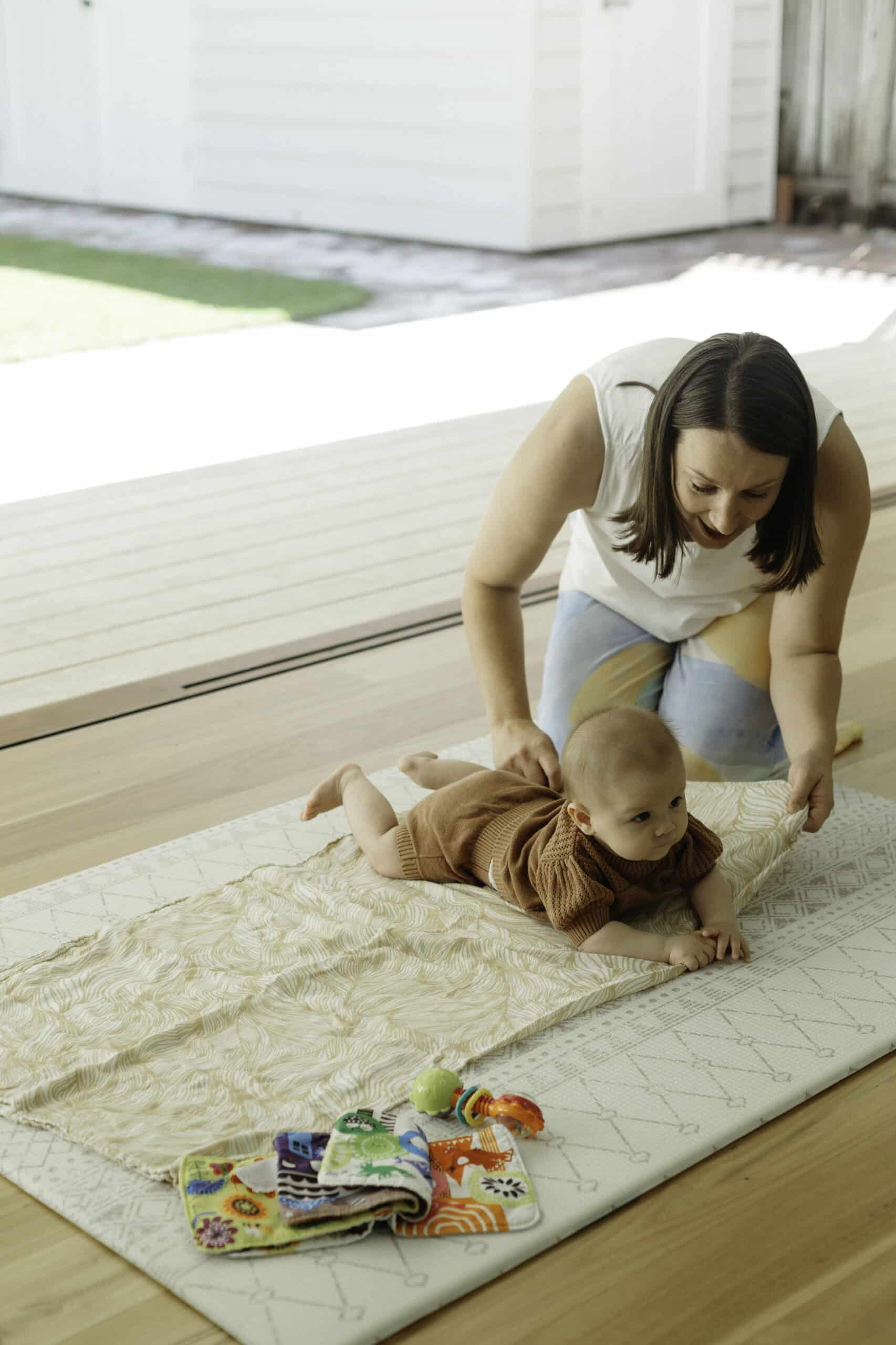
When your baby pushes up onto their hands and knees, they are taking weight through their shoulders, arms, wrists and hands. That builds strength and steadiness around the shoulders, and gives the hands lots of lovely sensory feedback. Holding that position also asks the deep tummy and back muscles to switch on and keep the body steady, which is good for posture. And moving opposite arm and leg together gives the body useful practice that feeds into coordination. Time spent on the floor in these positions, starting with tummy time, is linked with stronger gross motor development¹³. All good reasons to make room for crawling.
What the evidence does not show is anything magic or irreplaceable about it. Things do change in the brain around the age babies start crawling, near nine months, and researchers have measured some of it. When one team recorded the brain activity of babies with different amounts of crawling experience, the babies who had just started crawling showed more connection between brain regions than babies who had not started yet, and more than babies who had been crawling for weeks¹⁴. On its own, that can look like proof that crawling is doing something special.
Researchers then ran the same kind of study with walking instead of crawling, and found the same thing. Babies who had just started walking showed that same rise in brain connection, compared with babies who were not walking yet and babies who were already steady on their feet¹⁵. That points to something bigger than crawling. A baby’s brain seems to do this whenever it is learning a new movement. The connection builds while the skill is new and takes effort, then eases off as it becomes easy and automatic. Crawling shows the pattern, and walking shows it too. It looks like a brain in the middle of learning, which is a very different thing from a one-time bridge that only crawling can build.
There is also no brain scan study, using any tool, that shows crawling builds connections between the two sides of the brain in a way other movements do not. And so much is happening at that age all at once. Babies are getting into everything, working out that objects still exist when they are out of sight, becoming more sociable, and their brains are busy maturing across the board. Crawling turning up at the same time is not the same as crawling causing the rest.
Babies around the world move differently
This one matters, particularly here in Australia where so many families bring their own culture and traditions to raising children. I have worked with a family that carried their baby for the first 6 months because that was their culture- every family is different.
The idea that every baby should be down on the floor crawling by a certain age comes largely from Western culture rather than from biology. In lots of communities around the world, babies spend much of their early months carried, wrapped or held close, with very little floor time, and they do beautifully. In some cultures crawling is skipped almost entirely. In one body of research on Jamaican infants, close to a third skipped crawling, and some only started crawling around the same time they started walking¹⁸. In parts of Central Asia, babies are swaddled or held for long stretches, and once they are free to move about they go on to walk in their own good time.
Our milestone charts carry a bias worth knowing about. Most of the research behind them was done with Western, middle-income, mostly white families ¹⁹,²⁰. The charts are a useful rough guide rather than a universal law. When we treat them like one, we end up at risk of telling a family who carries their baby, exactly as their culture has always done, that their child’s brain is not “connected properly.” That is not backed by evidence, and it can knock a parent’s confidence and chip away at their trust in the people who are meant to be supporting them.
Where this idea came from
It is not new, and it did not come from brain scans. It goes back to two men, Glenn Doman and Carl Delacato, who suggested in the 1960s that children with learning difficulties had missed stages of movement like crawling, and that this had left their brains poorly organised. Their treatment was called patterning, and it had children repeat crawling movements again and again to “repattern” the brain and sort out reading and learning problems.
People looked into it properly, and it did not hold up. The American Academy of Physical Medicine and Rehabilitation flagged concerns back in 1968³. The American Academy of Pediatrics then reviewed patterning and concluded in 1982 that it had no special merit, that the claims behind it were unproven, and that the sheer demands it placed on families could in some cases do harm⁴. They updated that position in 1999, calling the theory behind it outmoded and oversimplified⁵.
The same idea keeps turning up in new forms. Brain Gym, a commercial program, sold the claim that particular cross-body exercises “switch on” the brain for learning. A review in 2007 found nothing solid behind it⁶. More recently, some practitioners argue that a baby who didn’t crawl the “right” way holds onto primitive reflexes that go on to cause attention problems, dyslexia or sensory issues, and that going back to crawling later will sort it out. The evidence for that “fix” is thin. Retained reflexes are a real and active area of research, and there is a documented link with things like attention and reading difficulties, but the studies testing reflex or crawling programs as a treatment are mostly small and low quality, and reviews keep pointing to a shortage of good trials⁷,⁸.
Teaching a child to crawl will not change an underlying diagnosis like dyslexia or ADHD. If that is your child, that is who they are.
They are not broken, and there is nothing about them that needs fixing.
Good early childhood practice is built around understanding a child, including them, and supporting them as they are, with all their strengths⁹. That does not mean movement has nothing to offer. Regular physical activity can genuinely help with the day-to-day impact of ADHD symptoms¹⁰. It helps as support, and it comes through everyday active play rather than one special set of exercises.
Here is something that has stuck with me. Researchers who study neuromyths, the false brain beliefs that float around schools and clinics, tested the exact claim that short bursts of coordination exercise improve how the two sides of the brain work together. The claim is false. Even so, a large share of teachers surveyed believed it was true¹¹. Training and good intentions do not make any of us immune to an idea that is just everywhere.
What the evidence does point to is broader. When children build a wide base of fundamental movement skills, the running, jumping, throwing, catching and balancing that make up active play, we tend to see flow-on benefits in areas like reading and maths¹². That broad movement foundation is what seems to matter, and it does not come from one specific exercise done in a set order.
The babies who don’t fit the theory
Some perfectly healthy babies never crawl. They bottom-shuffle, they roll, they commando along on their tummies, then they pull up and walk. They grow into coordinated, clever kids¹⁶.
In Australia where I work, I want to ensure that for kids that need it, they get the earliest access to care and intervention they can. That means using milestones like crawling as sign posts, to check where they are at in their developmental journey. If your baby isn’t doing certain things by a certain age, or maybe they are doing things differently, I like to do a thorough assessment. Sometimes this is a completely normal part of their development and you go on your merry way. Sometimes there might be something more underlying, and that’s where I (and other paeds physios) help to provide the early intervention that gives your baby the best possible opportunities.
What actually builds cross-body coordination
If you want to give your child’s coordination a hand, including crossing the middle of the body and moving opposite arm and leg together, the thing that helps is variety. Any single activity on its own does much less.
Loads of ordinary play does it. Climbing builds it, with the bonus of more balance and body-awareness work than crawling on a flat floor. Running, galloping, skipping and hopping all bring opposite arm and leg into play. So does swimming. So do throwing and catching across the body, kicking a ball, dancing, jumping rope and pedalling a bike. The research keeps bringing us back to the same point. Kids who get to have a go at a wide range of movements tend to have the best coordination overall¹². A single special exercise was never where the benefit came from.
What this means for you
If your baby is on the floor, having a go at shifting themselves about in whatever style suits them, you are already doing the main thing. A few practical thoughts on top of that:
- Give your baby plenty of supervised tummy time from early on. It sets up rolling, crawling and a lot more, and it is worth protecting.
- For toddlers and older kids, think variety. Playgrounds, climbing, water play, balls, dancing around the kitchen, all of it. Active outdoor play does more for coordination than any one set exercise.
- Watch your baby, not the clock. Babies get to their skills on their own timeline, and a really wide range of that is completely normal (but use my milestone guide as a bit of a fail safe that things are headlining in the right direction)
- If your baby is skipping several milestones, losing skills they already had, or something just feels off to you, trust that and go see your GP, child health nurse or a paediatric physio. Skipping crawling on its own, with everything else ticking along nicely, is not necessarily a reason to worry,, but a check over helps us know for sure.
You are the expert on your own baby. A good professional is there to back up what you already know, not to talk you out of it.
Questions worth asking your health professional
If someone tells you your child has to do a particular thing to “connect their brain” or “fix” a reflex, it is completely fair to ask a few questions. Good clinicians are happy to be asked.
- “What is the evidence for that? Is there research you can point me to?”
- “Is this the only way to build this skill, or one of a few?”
- “What would happen if we just did lots of varied play instead?”
- “Where does this idea originally come from?”
Asking is good parenting, and it is good practice too.
Common questions from parents
References:
- Development of the corpus callosum and cognition after neonatal encephalopathy. https://pmc.ncbi.nlm.nih.gov/articles/PMC9852393
- Cognitive and psychological impacts of congenital corpus callosum disorders in adults: A scoping review. (2023). Advances in Neurodevelopmental Disorders. https://link.springer.com/article/10.1007/s41252-023-00323-8
- American Academy of Physical Medicine and Rehabilitation. (1968). Doman-Delacato treatment of neurologically handicapped children. Archives of Physical Medicine and Rehabilitation, 49, 183-186.
- American Academy of Pediatrics, Committee on Children With Disabilities. (1982). The Doman-Delacato treatment of neurologically handicapped children. Pediatrics, 70(5), 810-812. https://publications.aap.org/pediatrics/article/70/5/810
- American Academy of Pediatrics, Committee on Children With Disabilities. (1999). The treatment of neurologically impaired children using patterning. Pediatrics, 104(5), 1149-1151. https://publications.aap.org/pediatrics/article/104/5/1149
- Hyatt, K. J. (2007). Brain Gym: Building stronger brains or wishful thinking? Remedial and Special Education, 28(2), 117-124. https://journals.sagepub.com/doi/10.1177/07419325070280020201
- McWhirter, K., Steel, A., & Adams, J. (2022). The association between learning disorders, motor function, and primitive reflexes in pre-school children: A systematic review. Journal of Child Health Care. https://doi.org/10.1177/13674935221114187
- Hirose, N., Tashiro, Y., & Takasaki, T. (2025). Effects of a 12-week exercise intervention on primitive reflex retention and social development in children with ASD and ADHD. Children, 12(8), 987. https://doi.org/10.3390/children12080987
- Early Childhood Intervention Australia. (2016). National Guidelines: Best Practice in Early Childhood Intervention. https://www.dss.gov.au/early-childhood/resource/ecia-national-guidelines-best-practice-early-childhood-intervention
- Zheng, R., Huang, S., Yang, J., Zhao, P., & Li, E. (2025). The therapeutic effects of physical activity on children with attention deficit hyperactivity disorder: A systematic review and meta-analysis. Medicine, 104(16), e42063. https://doi.org/10.1097/MD.0000000000042063
- Dekker, S., Lee, N. C., Howard-Jones, P., & Jolles, J. (2012). Neuromyths in education: Prevalence and predictors of misconceptions among teachers. Frontiers in Psychology, 3, 429. https://doi.org/10.3389/fpsyg.2012.00429
- Macdonald, K., Milne, N., Orr, R., & Pope, R. (2018). Relationships between motor proficiency and academic performance in mathematics and reading in school-aged children and adolescents: A systematic review. International Journal of Environmental Research and Public Health, 15(8), 1603. https://doi.org/10.3390/ijerph15081603
- Hewitt, L., Kerr, E., Stanley, R. M., & Okely, A. D. (2020). Tummy time and infant health outcomes: A systematic review. Pediatrics, 145(6), e20192168. https://doi.org/10.1542/peds.2019-2168
- Bell, M. A., & Fox, N. A. (1996). Crawling experience is related to changes in cortical organization during infancy: Evidence from EEG coherence. Developmental Psychobiology, 29(7), 551-561.
- Corbetta, D., Friedman, D. R., & Bell, M. A. (2014). Brain reorganization as a function of walking experience in 12-month-old infants: implications for the development of manual laterality. Frontiers in Psychology, 5, 245. https://doi.org/10.3389/fpsyg.2014.00245
- Evidence-based milestone ages as a framework for developmental surveillance. https://pmc.ncbi.nlm.nih.gov/articles/PMC3549694
- Davis, B. E., Moon, R. Y., Sachs, H. C., & Ottolini, M. C. (1998). Effects of sleep position on infant motor development. Pediatrics, 102(5), 1135-1140. https://pubmed.ncbi.nlm.nih.gov/9794945/
- Wang, Y., Karasik, L. B., Hewlett, B., & MacGillivray, T. (2025). Cultural diversity in infant motor development: A comparison of early locomotor experience. Journal of Cross-Cultural Psychology. https://journals.sagepub.com/doi/10.1177/00220221251321089
- Karasik, L. B., & Robinson, S. R. (2022). Milestones or millstones: How standard assessments mask cultural variation and misinform policies. Advances in Child Development and Behavior. https://www.karasiklab.org/wp-content/uploads/2024/03/karasik-robinson-2022-milestones-or-millstones-how-standard-assessments-mask-cultural-variation-and-misinform-policies-1.pdf
- Karasik, L. B., Adolph, K. E., Tamis-LeMonda, C. S., & Bornstein, M. H. (2010). WEIRD walking: Cross-cultural research on motor development. Behavioral and Brain Sciences, 33(2-3), 95-96. https://www.cambridge.org/core/journals/behavioral-and-brain-sciences/article/abs/weird-walking-crosscultural-research-on-motor-development/54FDEF21D44E33E7D34D2237A612F80C