Passionate – Dedicated – Professional

Passionate – Dedicated – Professional

Helping your child feel confident, comfortable, and independent in tackling toileting

You’re not alone. Bladder and bowel challenges are far more common in children than most parents realise. Our friendly continence team is here to support your family, wherever you’re starting from. We’re happy to answer every wee and poo question you never knew you needed to ask, without any judgment

Concerns and Questions you might have that our Continence Clinic can help with:
  • You are starting toilet training but not sure when to start? How old should your child should be? What approach you should use?

  • Your child is regularly wetting their underwear during the day, not making it to the toilet in time, or not seeming to feel when they need to go

  • Your child is still wetting the bed, they are over five years old and its bothering them?
  • Your child is finding toilet training difficult or is toilet training not progressing as expected?
  • Your child experiences constipation or complains of painful poos? Your child poos less than three times a week
  • Your child is often rushing to the toilet, needing to go very often, or feeling like they can’t hold on
  • Your child complains of pain in the tummy, pelvis, or bottom area that affects daily life and comfort
  • Your child is refusing to poo on the toilet and are hiding or insisting on a nappy
  • Your child is urinating less than four times a day or holding their wee for extended periods of time (eg whole school day)?
  • Your child is refusing or avoiding using school or public toilets? 
  • Your child is having difficulties with wiping or dressing themselves after using the toilet
  • You suspect that Food Allergies or Intolerances may be contributing to your childs constipation or soiling?

If you answered yes to one or more of these questions it might be time to get in touch!

Our Continence Clinic supports toddlers, children, adolescents, and young adults with bladder and bowel concerns, from toilet training to pelvic pain. We provide evidence-based therapy tailored to your child’s individual needs, focused on improving function, independence, and quality of life.

Depending on your child’s needs, they may see one or more members of our team: a Continence Physiotherapist, Occupational Therapist or Dietitian, all working together with your family or may be referred on to our Mental Health team

See Your GP First if

  • They complain of pain or burning when weeing
  • You see blood in their urine (wee)
  • Your child has a fever alongside toileting problems
  • They are urinating (weeing) less than three times a day
  • You suspect they might have a urinary tract infection (UTI)
  • Their stool (poo) is black, dark red or has blood or mucous in it.
  • They have not opened their bowels for more than seven days

Not sure if it’s the right fit? If it’s worrying you or your child, it’s always worth a conversation.

What does a visit look like?

Step 1 – Initial Assessment (~60 minutes)

A relaxed conversation with you and your child about their habits, history, and daily routine. We may ask you to complete a simple diary or questionnaire beforehand. If your child is four years of age or under, this first visit is usually a parent only appointment.

Step 2 – Your Child’s Personalised Plan

Therapy is tailored to your child and may include:

  • Education about how the bladder and bowel work
  • Fluid intake and dietary guidance
  • Toilet positioning and technique
  • Timed toileting schedules
  • Bladder awareness strategies
  • Bedwetting alarm guidance
  • Sensory or independence strategies from our OT
  • Dietary support from our Dietitian
  • Referral or coordination with your GP or paediatrician as needed

Step 3 – Ongoing Support

We monitor progress together and adjust the plan as your child improves.

All assessments are external and non-invasive.
Common Questions

No referral is needed to book directly with us. However, a GP or paediatrician referral may help with Medicare rebates under a care plan.

Our team sees children from 18 months through to 18 years, depending on the discipline. Completing our enquiry form assists us in triaging to the most appropriate service.

  • 18 months to three years: usually only seen if specific concerns regarding constipation or relevant medical history. We will advise you if we do not think the service is appropriate.
  • 3 year–5 years: Daytime toilet training is still developmentally normal. We’re happy to advise. Often we will recommend to start with occupational therapy, unless there are medical conditions involved.
  • Ages 5+: This is when we typically begin active assessment and treatment for bladder and bowel concerns.
  • Teenagers: Adolescents can also benefit from continence support, it’s never too late. Transition to adult services may be recommended from age 16.
All assessments are completely external and non-invasive. For an appointment with the continence physiotherapist, they may have an ultrasound assessment on their lower abdomen.
Our clinic consultations are based in clinic only, we do not currently offer school or home-based visits.
These services are not within our clinic’s scope. We recommend speaking with your treating hospital team or GP for a referral to the appropriate service.
This varies for every child. Usually you will have an initial assessment, then a follow up two weeks later and future session schedules are planned based on your child’s needs and presentation.
If you have an appropriate GP CCMP Plan you will receive a Medicare rebate. There will be a gap payment between what Medicare covers and the total cost of the appointment.

Please check with your private health if they cover the specific service you are seeing (ie physio or OT)

We go at your child’s pace. Everything we do is gentle, age-appropriate, and never invasive.
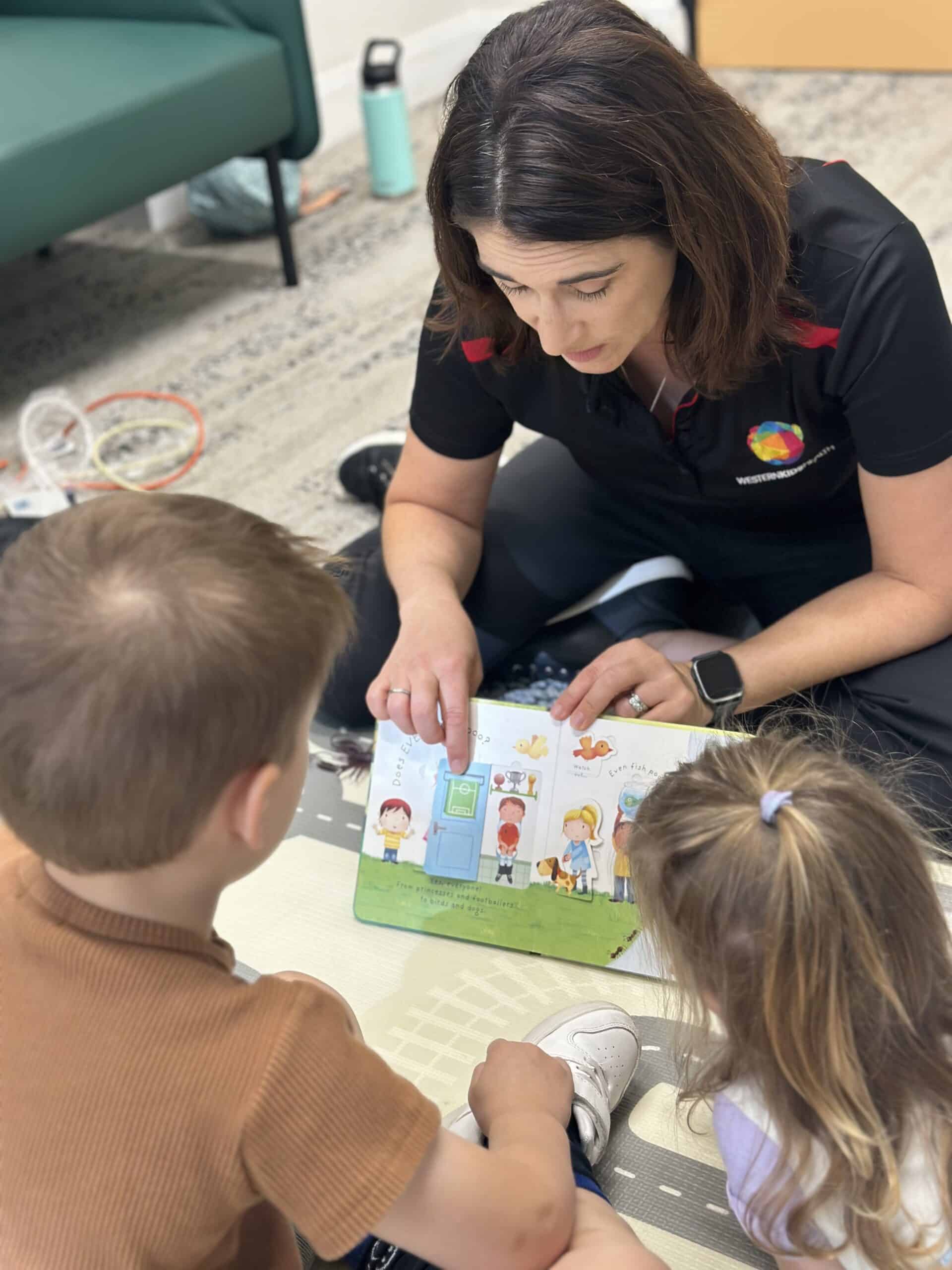
kids reading a book about toilet training

Passionate – Dedicated – Professional

Continence Team

Karina Caldwell

Lead Continence Physiotherapist

Karina Caldwell

Karina has recently joined Western Kids Health after spending the last 12 years living and working in Karratha.

Karina is a titled APA Continence and Women’s Health Physiotherapist and has undergone further training in the area of Paediatric Continence. With over two decades of clinical experience as a physiotherapist, recent years have seen her focus on the area of paediatric continence.

Karina works with children of all abilities to optimize their bladder and bowel function so that they can participate in activities of their choice. Collaboration with families and their therapists is important in maximizing outcomes and keeping therapy achievable

Bachelor of Science – Physiotherapy (Curtin University)

Master of Clinical Physiotherapy (Continence and Women’s Health) (Curtin University)

  • Paediatric Physiotherapy Level 1 and 2 (Australian Physiotherapy Association – APA)
  • Paediatric Continence Care e-course (International Children’s Continence society)
  • Bowel and Bladder Care for the Neurologically Involved Client (APA)
  • Treatment of the paediatric pelvic floor: birth to eighteen (APA)
  • Conquering the Wees and Poos Advanced course (Rebecca Kahn – OT)
  • ALERT program training
  • Pilates Instructor training course (400hrs)
  • Sports Physiotherapy Level 2 (APA)

Karina has been working as a physiotherapist for over twenty years and has worked in private practice, hospital and community service settings in Perth, the UK and the Pilbara.

Karina is passionate about providing quality, accessible, evidence-based care for children and their families in the area of paediatric continence and toileting. She focuses on a safe, open, fun approach to addressing bladder and bowel problems.

Karina also volunteers for Cosmos Alliance to provide updated education for primary health care workers in overseas communities such as Zimbabwe.

Outside of work she loves good coffee, umpiring netball, and spending time with her active sons and husband.

Karina has a strong interest in all aspects of paediatric continence, particularly supporting children to understand their conditions and creating their own goals.

brooke penny

Senior Accredited Practising Dietitian

brooke penny

Brooke is a caring and compassionate dietitian, working collaboratively with children and parents to develop practical and achievable solutions to their food and diet concerns. Brooke also works as part of the multidisplinary feeding team, helping toddlers through to teens to expand their diet and feel confident at mealtimes. Brooke’s ultimate aim is to alleviate the stress around food and make mealtimes an enjoyable experience.

BSC Nutrition, Masters of Dietetics,

  • Certificate in Paediatric Nutrition and Dietetics Unit 1 – Royal Children’s Hospital
  • Monash University Training – The Low FODMAP diet for Irritable Bowel Syndrome
  • ARFID Masterclass – Melanie Potock

Brooke graduated Curtain University in 2018, she worked with adults in the hospital and community settings before finding an interest in paediatrics. She has been part of the Western Kids Health team for 4 years.

Brooke also volunteers with the OnTrack program run by ADHD WA

Brooke’s area of special interests include:

  • Fussy eating / food aversions
  • Growth faltering / weight management
  • Gastrointestinal issues (IBS, constipation)
staci grant

Senior Occupational Therapist

staci grant
Staci has a passion working in early intervention with children aged 0 to 4 years old.
Staci understands that there is no “one size fits all” when it comes therapy and values an individualised and flexible approach to suit each person. She is passionate about family education and capacity building as a foundation for early intervention. Staci believes that supporting a caregiver’s confidence and understanding of their child’s needs is the key to positive long-term outcomes for both the child and family.
Outside of work, Staci has her hands full with two young children and a feisty dog. She enjoys spending time outdoors with her family and even has a go at sourdough baking – although yet to master that one!
Staci holds a Bachelor of Science (Occupational Therapy) from Curtin University. She strongly values ongoing learning and professional development to keep up to date with best practice and provide quality therapy provision. Her recent professional development includes:
  • Normal Movement Workshop by Australian Bobath Neuro-Developmental Therapy Association Inc.
  • Classification of Cerebral Palsy by Australian Bobath Neuro-Developmental Therapy Association Inc.
  • Sleep Quality for Health Professionals
  • Upper Limb Movement of Children with Cerebral Palsy – Perth Children’s Hospital
  • Screening Hand Assessment for Infants (s-HAI)
  • Winnie Dunn Conference for Sensory Processing by Winnie Dunn
  • ‘Traffic Jam in My Brain’ Sensory Processing Workshop by Genevieve Jerub
  • Learn to Play Therapy – Part 1
  • DIRFloortime 101
Staci has worked in paediatrics since graduating from university, with experience in private practice, community disability and at Perth Children’s Hospital. Her diverse experience provides a well rounded insight and expertise in working with children with a wide range of presentations of neurodiversity, developmental skills and physical capacity.
Staci enjoys providing education to the wider community and is involved in presenting in workshops and professional development opportunities for Playgroup WA, day cares and new graduates.
Staci runs our All the Feels group which is a workshop for parents about toddler behaviour and emotions. She has a few other groups in the pipeline – watch this space!
Staci enjoys working in a variety of different areas, including:
  • Emotional regulation
  • Behaviour
  • Sensory processing,
  • Upper limb and fine motor skills
  • Independence
  • Play skills