Osgood-Schlatter Disease: A Guide for Sporty Kids and Their Parents
By Nicola Moore | Senior Physiotherapist | Western Kids Health
“My knee has been killing me after footy training…”
Sound familiar? If your child has come home limping, complaining of a painful, tender lump just below their kneecap, there’s a good chance they’ve got something with a very impressive-sounding name: Osgood-Schlatter Disease.
Don’t let the name scare you, it’s actually one of the most common knee complaints in active kids, and the good news is, it’s very manageable.
So, what is Osgood-Schlatter disease?
Osgood-Schlatter disease (OSD) is best described as an irritation of the growth plate on the front of the upper tibia, otherwise known as the shin bone. This bony spot right below your kneecap (patella) is known as the tibial tuberosity. The patella tendon attaches the patella to the shin bone. This tendon plays a crucial role in the mechanics of running, jumping and all things sporty.
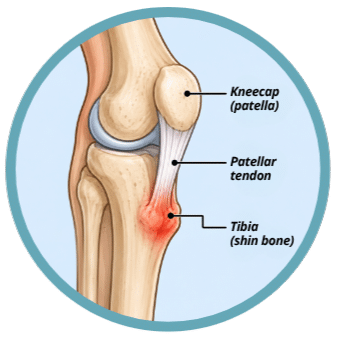
During a growth spurt bones grow rapidly, and the muscles and tendons can struggle to keep up. When a child is running, jumping, kicking, or sprinting, the thigh muscles pull hard on the patellar tendon. This then pulls the immature growth plate repeatedly throughout the sports season.
Over time, the tibial tuberosity can become swollen and form a small, bony lump which can look a bit dramatic but is usually just a sign that the body has been laying down new bone in response to the stress.
Who Can Get It?
OSD is most common in sporty kids who are going through a growth spurt- so if your child is active AND shooting up in height, they are more at risk.
- 10% of adolescents are affected by OSD ¹.
- Boys most commonly between ages 10-15 years² ⁶.
- Girls most commonly between ages 8-13 years² ⁶.
- OSD develops approximately twice as often in those who are active in sports compared with non-athletes³.
- Sports commonly associated include football, basketball, volleyball, gymnastics, and sprinting² . Netball is not named in the literature as it is not widely played outside Australia, NZ and the UK but has the same mechanics.
What Does It Feel Like?
Classic signs your child might have OSD:
- Pain at the front of the knee, just below the kneecap
- Pain that gets worse during or just after sport
- A tender, bony lump that hurts if you press on it or bump it
- Pain with running, jumping, squatting, kneeling, or climbing stairs
- Pain that eases with rest but flares back up when activity resumes
- Sometimes the area looks a little red or swollen
The pain can range from a mild niggle to a genuinely significant ache.
Do We Need Scans or X-Rays?
Probably not. OSD is usually diagnosed by a physiotherapist or doctor through a simple clinical examination. X-rays are generally not necessary, though your doctor may order one if they want to rule out other causes of knee pain.
Does My Child Have to Stop Sport?
Here’s the bit every sport-mad kid (and their parents!) really wants to know.
The short answer: not necessarily!
The old-school approach used to be “stop all activity for 6 to 12 months”. These days, we know that’s not needed and can honestly be pretty hard on a kid’s mental health, and enjoyment of sport.
The modern, evidence-based approach is all about smart load management: keeping your child active, but within a pain range that allows recovery ⁷⁸⁹¹⁰.
Practically, this might look like:
- Reducing training volume by around 25% (e.g., dropping from 4 sessions to 3 per week).
- Modifying the type of activity (less jumping and sprinting, more swimming or cycling during a flare).
- Using pain as a guide (If it’s below a 3 out of 10, activity is usually fine).
- Taking a break for 1 or 2 seasons, only if pain is severe.
The key message: continuing sport is not harmful in itself, but pushing too hard can make symptoms flare.
Your OSD Toolkit
1. Ice
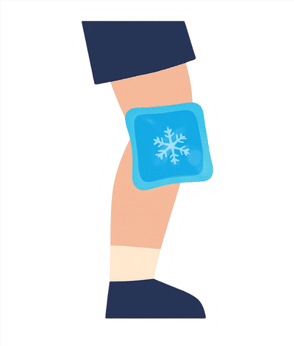
Applying an ice pack to the sore area can help reduce inflammation and ease pain. Apply for 10-15 minutes after activity ¹.
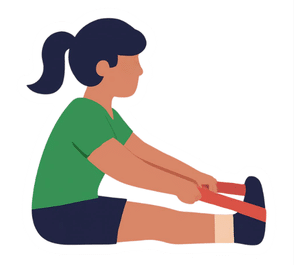
2. Stretching
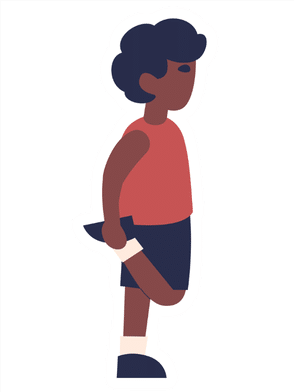
Tight quads and hamstrings are a big contributor to OSD symptoms. Regular, gentle stretching of the thigh muscles (both front and back) can make a real difference ¹.
3. Strengthening Exercises
Building strength in the quadriceps, hamstrings, glutes, and lower limb muscles helps the knee tolerate the demands of sport better. Wall sits, glute bridges, and body-weight squats are all great starting points – your physio will tailor these to your child’s level ⁴.
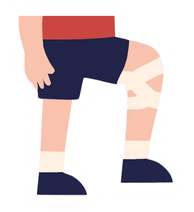
4. Taping Or a protective sleeve
Taping the bony prominence, or wearing a patellar tendon strap (a small brace worn just below the kneecap), can help offload some of the stress and keep kids on the field.
5. Footwear Check
Foot biomechanics influence the forces travelling up to the knee. A physiotherapist or podiatrist can assess your child’s footwear and gait, and sometimes orthotics can help manage knee loads.
6. Pain Relief
Anti-inflammatory medications can help during painful flareups. Check with your pharmacist or GP for the right dose for your child’s age and weight ¹
Will It Ever Go Away?
Typically OSD is a self-limiting condition, meaning it resolves on its own once the growth plates fuse. For most kids, that means by the time they’re in their late teens, the pain is completely gone ⁵.
That said, it can take some months to settle, and symptoms can recur during growth spurts or heavy training periods – so a bit of patience and consistency with management is key.
A small bump (the tibial tuberosity) may remain even after the pain has gone. This is usually harmless, though it can occasionally make kneeling a bit uncomfortable later in life.
In a very small number of cases where a fragment of bone causes ongoing problems in adulthood, surgery may be discussed. This is rare and only considered after growth is complete and conservative treatment has been fully explored.
When Should We See a Physio?
A physiotherapist is ideally placed to diagnose OSD, set up a load management plan, and guide your child through a strengthening programme to get them back to full sport as smoothly as possible. If your child is limping, missing training, or their pain isn’t settling with basic rest and ice, it’s well worth booking in.
A good physio will work around your child’s sport commitments. The goal is always to keep them playing, just smarter with a few adaptations.
A Note for the Kids Reading This:
We know it’s really frustrating.
You want to be out there with your teammates, and instead your knee is screaming at you. Here’s the thing: this is actually a sign that your body is working hard and growing. With the right help, most kids with OSD go on to play sport at every level they aim for. Listen to your body, do your exercises, and trust the process.
You’ve got this.
This blog is intended as general health information. For a diagnosis and personalised management plan, please see your physiotherapist or GP.
References
1. Neuhaus C, Appenzeller-Herzog C, Faude O. A systematic review on conservative treatment options for Osgood-Schlatter disease. Phys Ther Sport. 2021;49:178–87.
2. Lucenti L, Sapienza M, Caldaci A, Cristo C, Testa G, et al. The etiology and risk factors of Osgood-Schlatter disease: a systematic review. Children (Basel). 2022. Available from: https://www.mdpi.com
3. Haines M, Pirlo LB, Bowles KA, Williams CM. Describing frequencies of lower-limb apophyseal injuries in children and adolescents: a systematic review. Clin J Sport Med. 2022;32(4):433–9. DOI: 10.1097/JSM.0000000000000925
4. Rathleff MS, Winiarski L, Krommes K, Graven-Nielsen T, Hölmich P, Olesen JL, et al. Activity modification and knee strengthening for Osgood-Schlatter disease: a prospective cohort study. Orthop J Sports Med. 2020;8(4):2325967120911106.
5. Smith JM, Varacallo M. Osgood-Schlatter Disease. In: StatPearls [Internet]. Treasure Island (FL): StatPearls Publishing; 2023 [updated 2023 Aug 4]. Available from: https://www.ncbi.nlm.nih.gov/books/NBK441995/
6. Holden S, Lyng K, Olesen JL, Sørensen LB, Rathleff MS. Understanding the interactions between loading, pain dynamics, and imaging characteristics for Osgood Schlatter: a cross-sectional study. Scand J Med Sci Sports. 2024. DOI: 10.1111/sms.14729
7. Rathleff MS, Winiarski L, Riel H, Vicenzino B, Thorborg K, Holden S, et al. Activity modification and load management of adolescents with patellofemoral pain, Osgood-Schlatter disease, and Sinding-Larsen-Johansson disease: a prospective cohort study. Orthop J Sports Med. 2020;8(7):2325967120932100.
8. Kujala UM, Kvist M, Heinonen O. Osgood-Schlatter’s disease in young athletes. Am J Sports Med. 1985;13(4):236–41.
9. Neuhaus C, Appenzeller-Herzog C, Faude O. A systematic review on conservative treatment options for OSGOOD-Schlatter disease. Phys Ther Sport. 2021;49:178–87.
10. ClinicalTrials.gov. Pain-guided activity participation versus rest in Osgood-Schlatter disease [NCT05826340]. Bethesda (MD): National Library of Medicine (US); [cited 2024]. Available from: https://clinicaltrials.gov/study/NCT05826340