Backyards, balls and big cousins: what really shapes your child’s motor development
By Nicole Pates | Paediatric Physiotherapist | Western Kids Health
If you have ever wondered whether you should be enrolling your toddler in baby gym, buying the latest climbing toy, or doing structured “exercises” with your two year old to help their motor skills along, this one is for you.
A large Australian study followed children from babyhood to age five to see which everyday home and family factors actually predicted how well they moved at school age. The findings are reassuring, practical, and a bit countercultural. The things that mattered most were not classes, gear, or parent-led drills. They were the ordinary stuff of family life.
Here is what the research actually found, and what it means for you.
What the research actually found
Barnett and her team (2019) followed families from the Melbourne InFANT Program, with up to 259 children included at different time points. Mums answered questions about their child’s home environment and behaviours at 4 months, 9 months, 19 months, and 3.5 years. At age five, the children were assessed on twelve fundamental movement skills like running, jumping, throwing, kicking and catching.
Three things stood out as the most consistent predictors of better motor skills at age five.
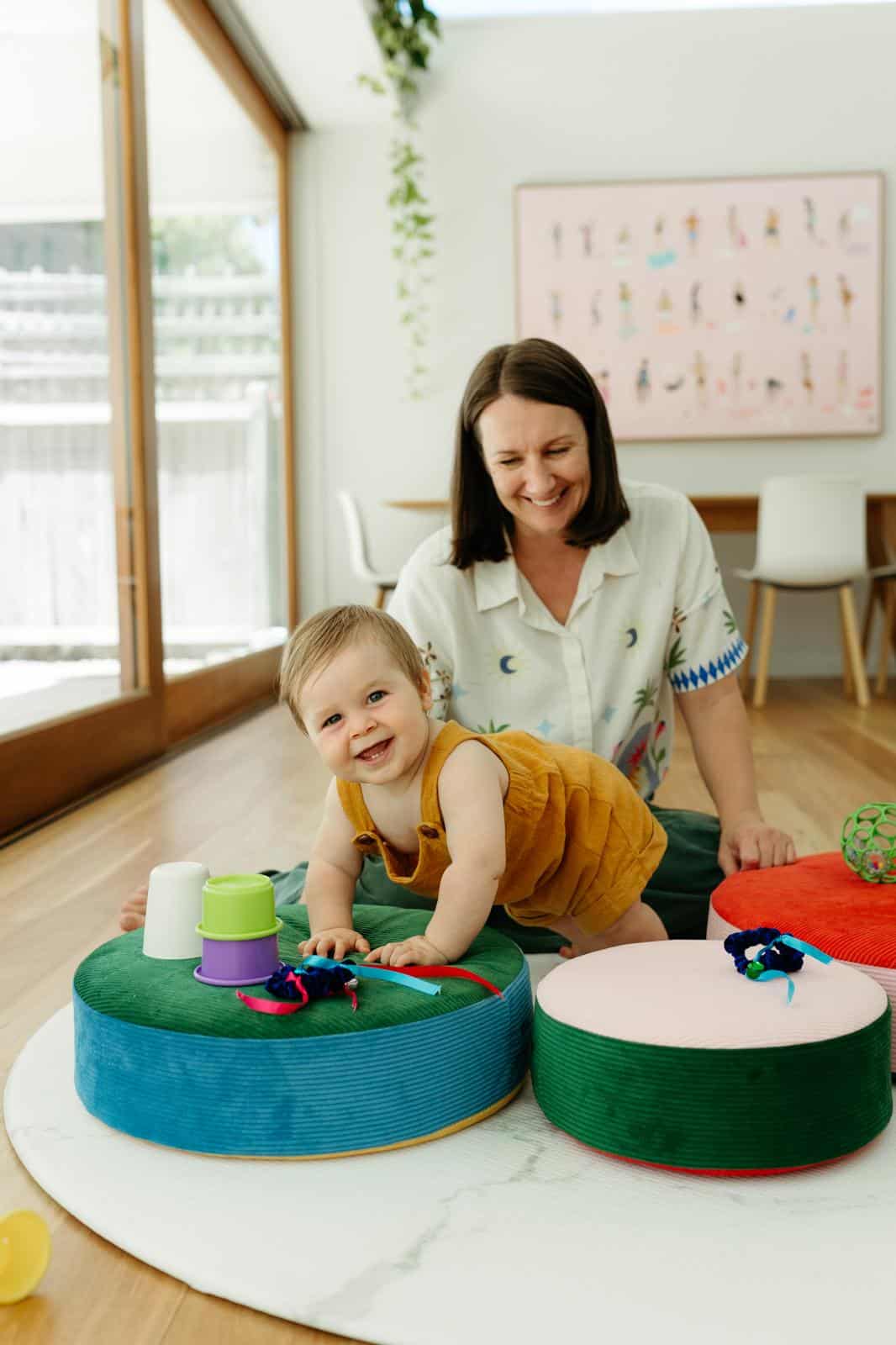
Variety of physical activity equipment at home. This was the strongest and most consistent finding across the whole study. Babies who had more age-appropriate movement items available at home went on to have better motor skills at age five, across both running-and-jumping type skills and ball skills. This was true at 9 months and again at 3.5 years.
Freedom to move at toddler age. Toddlers around 19 months who had roughly 70 minutes or more per day of unrestricted time to move about had better motor skills at age five. That is time out of the pram, the high chair, the car seat, the baby carrier. Time on the floor, in the backyard, on the grass, on the rug.
Time with older children. Babies, toddlers and preschoolers who spent more time with older children, whether siblings, cousins, kids at playgroup or kinder, had better motor skills at age five. Younger children watch older children move and then copy them. They see what is possible.
What didn’t show up as a make or break factor
This is the part that might surprise you.
Organised classes like baby gym and learn-to-swim did not predict motor skills at age five in this study. That does not mean these classes are not good. Swim lessons matter for water safety. Music and movement classes are lovely for connection. And the main reason I signed up my kids for classes as babies and toddlers? So I could speak to another adult, make a friend… for my own wellbeing. But if you are feeling pressure to enrol your toddler in structured activities to make sure they “develop properly”, you can let that pressure go.
Parent-led facilitation of physical activity also did not predict motor skills. In other words, mums who reported actively trying to facilitate their child’s physical activity did not have children with better motor skills than mums who reported doing less of this. The researchers suggest this might be because what parents count as “facilitating” varies a lot, and because the quality of engagement matters more than the quantity.
The takeaway from both of these findings is the same.
You do not need to be your child’s movement coach.
Your job is to set up the environment and let your child explore it.
A quick note on tummy time
The Barnett study did not find a link between tummy time in babyhood and motor skills at age five, but the researchers were careful to point out this was likely a measurement issue. They only measured tummy time at one time point, at 4 months.
A more recent Canadian study by Carson and colleagues (2022) followed 411 babies and found that more tummy time across the first six months was linked to earlier sitting, crawling, standing and walking, and better gross motor development overall. So tummy time still matters in those early months, especially for head control, shoulder strength and the postural foundations babies need before they can sit, crawl and walk.
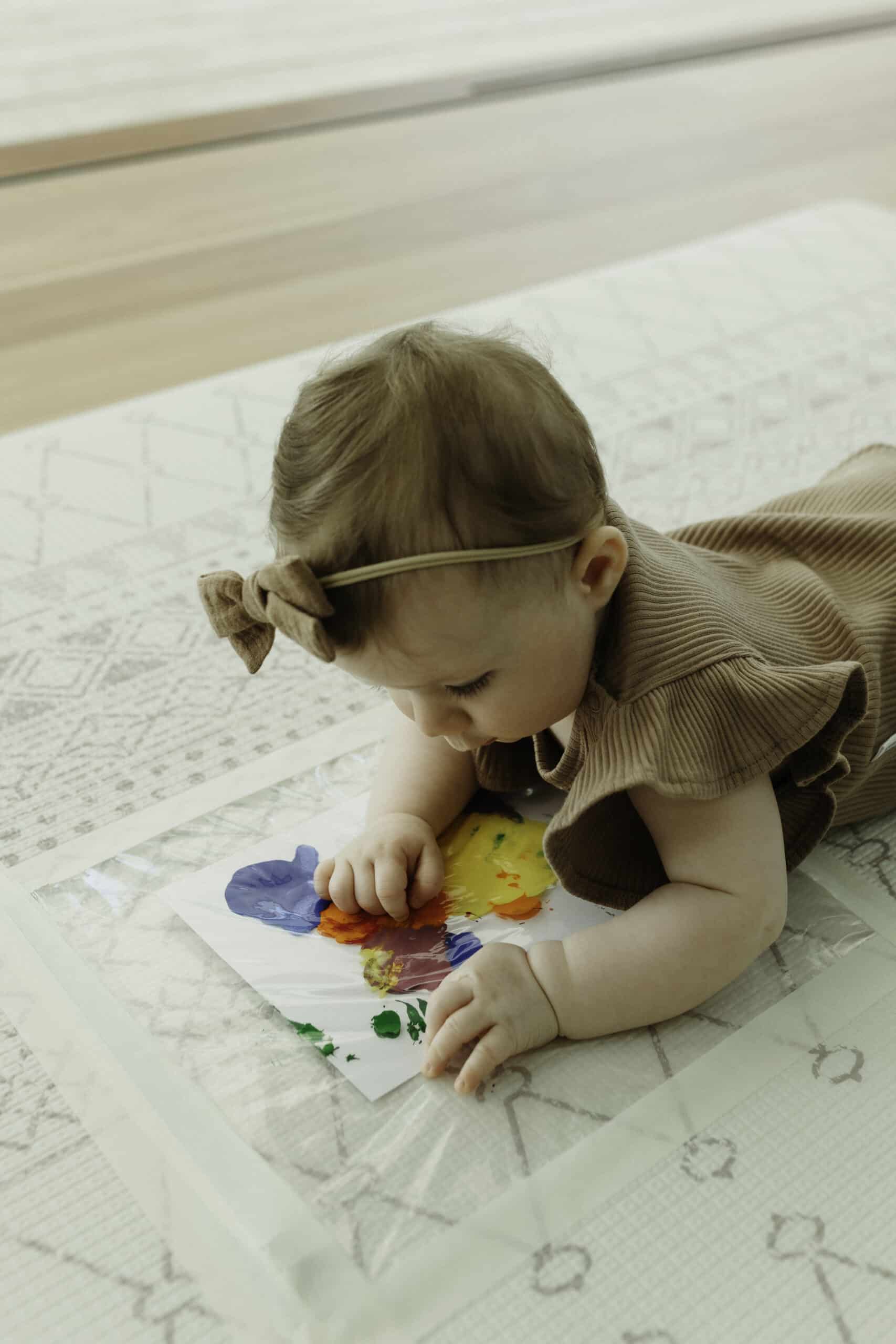
Here is what is really cool about this. If tummy time has not gone smoothly in those first few months, there are other things you can do that support your little one’s motor development. Opportunities to get out and move. Physical activity equipment (yes, even the upside down washing basket counts as something to push along). And time with older children, who show your little one what is possible and give them the confidence to stretch themselves. Hello, risky play.
It is not all riding on tummy time, there is a whole runway ahead.
What does “equipment” actually mean?
When you hear “physical activity equipment at home” matters, it is easy to feel like you need to go and buy more stuff.
The good news is, variety is the key, not the price tag.
The research measured a pretty grounded list of items. For babies and toddlers, things like balls, push-along toys, and a sandpit. For 3.5 year olds, the list expanded to balls, bats and rackets, a bike or ride-on, climbing equipment, a trampoline, swings or slides, a swimming pool, a skipping rope, a scooter, and other toys that encourage active play.
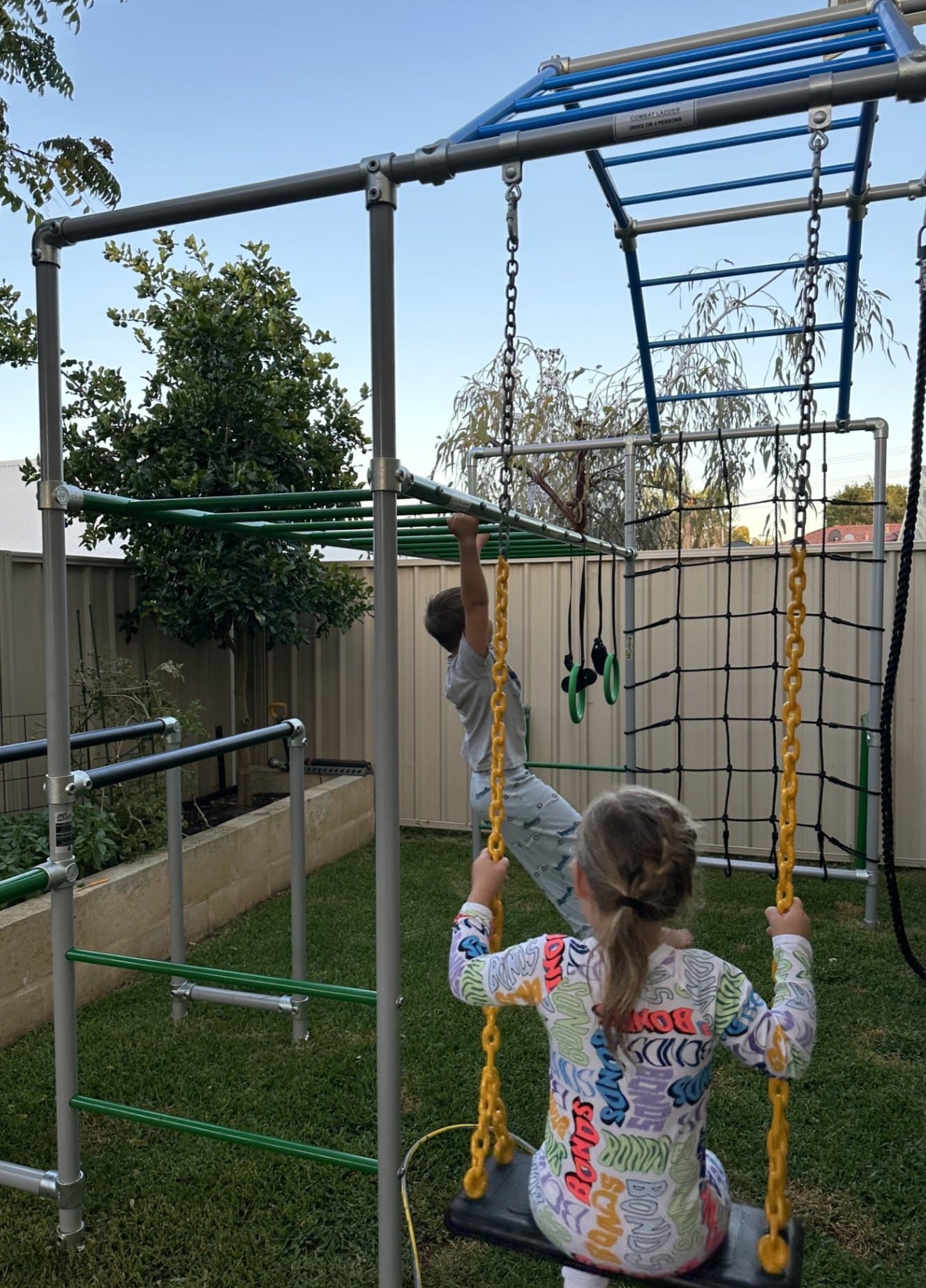
So variety does matter. Different items invite different movement patterns. A ball builds different skills to a ride-on, which builds different skills to a climbing frame.
But the way you create that variety is entirely up to you and following your little ones preferences is also important.
Scooters are not better than balance bikes, or vice versa. Both encourage active play, balance, bilateral coordination and visual-spatial skills.
Toy libraries are one of the best kept secrets for young families. For a small annual fee you can borrow different equipment each week, which means your child gets variety without your house filling up and your wallet emptying out. Most local councils in WA have one, and Toy Libraries Australia has a finder on their website.
Hand-me-downs and family swaps are the other big one. A trampoline from a cousin who has outgrown it, a balance bike from a neighbour, a ride-on toy from a friend whose kid has moved on. Buy nothing groups, marketplace, op shops and family networks are full of this gear.
A few things I need to point out. Variety is the spice of life and it matters more than expense. You also do not need every item on the list. Pick what fits your space, your budget, and your child’s stage. A ball, something to climb on, something to ride or push, and a bit of space to use them is plenty to start with.
A question worth sitting with
The research is pretty clear that variety of equipment, freedom to move, and time with other children are the biggest drivers of motor development. So I keep wondering.
What happens as backyards keep shrinking?
As new builds go up with barely any outdoor space?
As playgrounds get designed to remove every possible risk?
As families spread out and younger kids spend less time around older cousins and neighbourhood kids?
I am not asking this to make anyone feel guilty about where they live or how their street is set up. I mean, you are not the town planner demolishing every tree and making parks tiny and ultra safe. Come on council, do BETTER.
But I do think it is worth noticing what our kids might be losing access to, and getting a bit more intentional about creating those opportunities where we can.
A playgroup with a mixed-age range.
A regular park visit with intentional risky play.
A trip to grandma and grandads with the older cousins.
Heading to the local pump track with the balance bikes.
An afternoon at a friend’s place where the kids run wild in the backyard and the adults drink hot coffee on the deck.
Based on this research, these simple strategies look like some of the most powerful things we can offer our kids. It doesn’t have to be everyday to make a difference.
What this means for you
If you take one thing from this blog, take this.
Your everyday home environment is the engine of your child’s motor development.
The toys you already have.
The backyard, balcony or rug you already use.
The playgroup down the road.
The older cousin who rocks up on weekends.
These are the things are CRUCIAL.
A few practical thoughts.
Have a variety of movement items available, even simple ones.
Rotate them so they feel fresh.
You do not have to buy more, just use what you have differently. (And if you do want to add variety without buying, toy libraries are gold.)
Give your toddler real chunks of time out of the pram, high chair and car seat. The research points to around 70 minutes or more per day of free movement time at the toddler stage as genuinely useful. If today was a big traffic day with lots of time in the car or the pram (hello school pick ups, appointments, errands), see if tomorrow can have a bit more floor time, backyard time, or park time to balance things out.
Prioritise time with other children, especially older ones. Playgroup, kinder, family gatherings, play dates, they all count. If you have an only child, regular playgroup attendance is a particularly strong argument based on this research.
And then trust your kiddo to do the rest. You do not need to coach, drill or instruct. You are the safe base they explore from, and the welcome back when they need it. That is the role.
The everyday is enough, it always has been.
References
Barnett, L. M., Hnatiuk, J. A., Salmon, J., & Hesketh, K. D. (2019). Modifiable factors which predict children’s gross motor competence: a prospective cohort study. International Journal of Behavioral Nutrition and Physical Activity, 16(1), 129. https://doi.org/10.1186/s12966-019-0888-0
Carson, V., Zhang, Z., Predy, M., Pritchard, L., & Hesketh, K. D. (2022). Longitudinal associations between infant movement behaviours and development. International Journal of Behavioral Nutrition and Physical Activity, 19(1), 10. https://doi.org/10.1186/s12966-022-01248-6
Hnatiuk, J., Salmon, J., Campbell, K., Ridgers, N., & Hesketh, K. (2013). Early childhood predictors of toddlers’ physical activity: longitudinal findings from the Melbourne InFANT program. International Journal of Behavioral Nutrition and Physical Activity, 10(1), 123. https://doi.org/10.1186/1479-5868-10-123