Our Tortally Cool Torticollis Journey
Hi, my name is S, and I’m the proud Mumma Bear to G (seven) and F (five). I wrote these words after the birth of my second son, when I was finally able to reflect upon the journey we had been on the first time around.
I want to share our torticollis journey in the hope that it helps someone else riding the same tumultuous wave.
Between endless Googling, child health appointments, physiotherapy, chiropractor visits, paediatricians, and doctors, it took a while to find the reassurance I so desperately needed. As a first-time mum, I was so worried… about everything. I was vaguely aware I was flagging high for postnatal anxiety, but it’s only now- after the birth of my second son- that I realise just how anxious I really was.
Statistics show that around 3 in 100 babies are affected by torticollis, with boys and girls equally impacted. It varies in severity and in the level of intervention required.
We’re still unsure what caused G’s torticollis- whether it was due to his position in the womb or the vacuum-assisted birth. Looking back, I never felt him flip or somersault- he certainly kicked a lot, but those big turning sensations never came. During the vacuum delivery, we later discovered he had twisted, and the suction cap had to be placed on the side of his head, causing a large hematoma. It would have been painful for him to turn his head to that side.
Whatever the cause, the outcome was clear- we needed to act early to prevent abnormal head growth, delays in motor development, and plagiocephaly.
These days, G is your typical 2-year-old; he loves running around, being outside, and exploring. He hits all his milestones and is developmentally right on track…
But it wasn’t always so sweet.
How it started
I had a normal, cruisy pregnancy until around 32 weeks, when a scan raised suspicions of IUGR (intrauterine growth restriction). I was told I’d be lucky to reach 37 weeks and would likely be induced if I did. As a first-time mum, I was devastated- my ‘birth plan’ was slipping away. But of course, I’d do anything to keep my baby safe.
Thankfully, IUGR was ruled out by 35 weeks (ironically, G was born weighing 3.26kg—certainly not growth-restricted!). Things settled again until a scare at 36 weeks when, during a routine check-up, his heart rate plummeted. I was sent straight to the hospital for monitoring, which then became an every-other-day event. I was eventually induced at 39 weeks.
In hindsight, this began what I now understand to be the ‘chain of intervention’- something I was completely unaware of at the time. G and I were both in distress during labour due to synthetic contractions, and concerns for his well-being escalated.
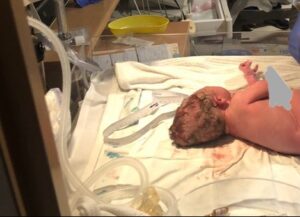
He was eventually delivered via vacuum moments before an emergency C-section would have been necessary. Due to the rush at the end and the stress of labour, G had twisted, and the vacuum was placed on the side of his head, resulting in a large hematoma.
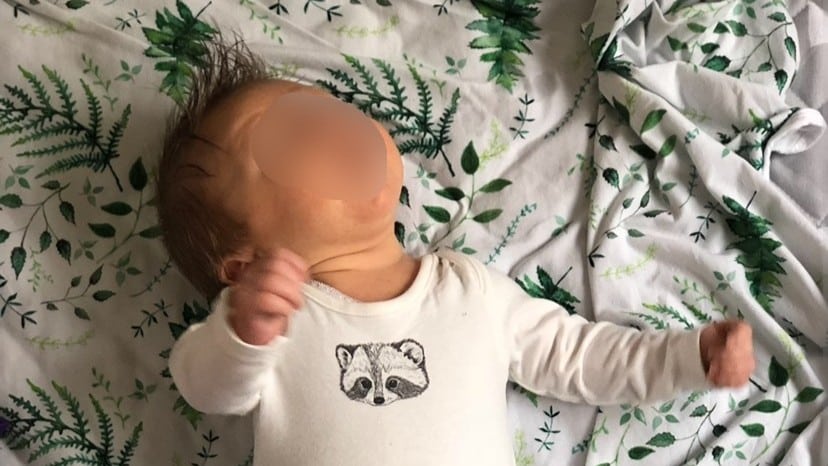
I first noticed G’s head preference around two weeks old. Looking back at photos, it’s clear the head tilt was there from one week- if not earlier. But at the time, we just thought it was a cute little newborn quirk. Oh, how naive we were.
Seeking Support
We’d been trying to rotate his head when we laid him down (which wasn’t often, as he loved being in our arms), but he always defaulted to looking up and to the left.
As a very anxious mum, I took him to a drop-in session with the Child Health Nurse. Torticollis was first flagged in June 2018. They showed me different stretches to try with him, but I found it overwhelming, delivery was blunt, and no reassurance was given. Due to the tightness they observed, we were referred to WKH and the state developmental team. It was daunting for an already anxious Mumma, and I left that appointment feeling confused and scared.
G and I first went to WKH in June 2018, and that’s when his physiotherapy journey began. WKH was a total game-changer. I knew G was in safe, capable hands, but I also felt that I was too. When the facility moved, I was blown away by the resources available to us.
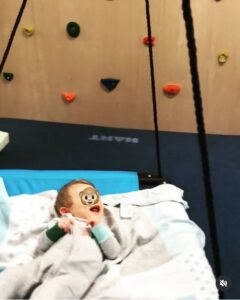
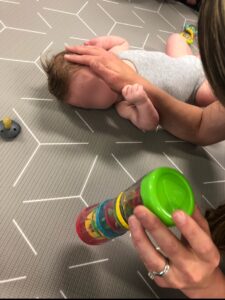
I’m so grateful for all the help we received, but there was a stark difference in support between the health professionals I was seeing. At WKH, every single person genuinely cared about G’s wellbeing- and mine. I’ll never forget the time I arrived flustered after a car ride with a screaming G (he hated the car, likely due to his torticollis).
My physio looked at me, said, “Don’t worry, we’ll reschedule,” and led me to a quiet, calm and comfortable space to breastfeed and brought me a glass of water. That meant the world.
The Homework
The “homework” was hard. The stretches were intense and time-consuming, and I know we both came to dread them. It’s heartbreaking to make your child uncomfortable, even when you know it’s for the greater good.
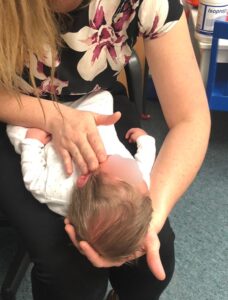
When I shared this with my physio, she showed us how to integrate the stretches into play- like during tummy time, carrier stretches, nappy changes, the Superman hold, using dangly toys, or on the fit ball.
The Challenges and Guilt /strong
The hardest part was letting go of the mum guilt. Even now, with two little humans I adore, the mum guilt lingers daily.
After having G, I struggled with postnatal anxiety, more than I realised at the time. I was so certain something was going to be wrong with him. When we got the torticollis diagnosis, I was devastated. I blamed myself.
Why did I agree to the induction? (Because it was medically necessary.) Why did I have the epidural? (Because the synthetic contractions were unbearable.)
Why couldn’t I give him more room in the womb? (Because that’s just how my body is.) Did I hold him too much on one side? Not turn him enough in his sleep? What had I done wrong?
There were daily challenges. Breastfeeding was even harder due to his head preference – he always favoured the right side. Car rides were awful because he was clearly uncomfortable in the seat.
Plagiocephaly (flat head) became a big concern. Since G always looked up and left, the right side of his head became a bit flat. At every WKH session, we took photos and measurements to track it. We even discussed helmet therapy if needed, which worried me more, but I was given all the information I needed.
We changed how we held him to encourage him to stretch toward the right. I’d wait until he fell asleep in the carrier and gently turn his head, then hold it there while he slept, because if I let go, it would spring back. We approached him from the right, sat on his right, played on his right. Every nappy change became an opportunity for therapy.
It was a long, hard road, full of tears (so many tears) but there were smiles too. My husband recently admitted that he hadn’t realised how bad it was until he looked back at old photos. Now he understands the pressure I was under to get those stretches done, even on the hardest days.
Probably the worst thing I did was blame myself. And Google. Oh, the Googling. The amount of time I spent researching plagiocephaly, convinced G would have a flat head forever, was next level.
We Made it!
But… we made it. We were officially discharged from physiotherapy in March 2019, nearly nine months after G was born. When the discharge letter arrived, I cried my eyes out. With the help of WKH and the amazing team, we did it.
My Advice
If I could offer any advice…
- Early intervention is key (if appropriate).
- Incorporate tummy time and strengthening exercises into everyday play so they don’t feel like one more task on your already overwhelming list.
- Build your village and let people in (still working on this myself).
- It’s OK not to be OK and everyone’s version of “OK” is different.
- Most of all: Be kind to yourself.
Thank you for taking the time to read our torticollis journey – Mumma S
Thank you for taking the time to read Mumma S’s story about her journey with her first born G, and their torticollis. If you are worried that your baby has a torticollis or plagiocephaly, please reach out to your local paediatric physiotherapist, GP or child health nurse.
You can also contact our team at Western Kids Health for support and advice.